Most businesses struggle to generate consistent leads because they focus on tactics instead of strategy. A data-driven digital marketing approach helps improve visibility, attract qualified traffic, and convert visitors into customers.
The right combination of SEO, Google Ads, content marketing, and conversion optimization creates sustainable growth. Success comes from understanding user intent, measuring performance, and continuously improving campaigns.
Search is changing faster than ever. In 2026, businesses are no longer competing only for traditional blue-link rankings. They are also competing for visibility inside AI-generated search results, especially Google AI Overviews. According to Google, AI Overviews now has over 2.5 billion monthly active users, and AI Mode has surpassed 1 billion monthly active users, showing how quickly users are adopting AI-powered search experiences.
For businesses, this shift creates both a challenge and an opportunity. If your content appears in AI Overviews, your brand can earn visibility at the top of the search results page. If it does not, your competitors may capture attention before users even scroll to organic listings.
This is where an experienced aio consultant can help businesses understand how AI-powered search works and how to optimize content for better visibility. AI Overviews are not just another SEO feature. They represent a new way Google summarizes, explains, and presents information to users.
In this guide, you will learn what AI Overviews are, how they work, why they matter, and how to rank in AI Overviews using practical SEO strategies for 2026.
AI Overviews are AI-generated summaries that appear in Google Search for selected queries. Instead of only showing a list of websites, Google may provide a summarized answer at the top of the results page with supporting links.
Google explains that AI Overviews help users understand complex topics faster and explore related sources for more information. These results are designed to appear when Google believes an AI-powered summary can add value beyond traditional search results.
For example, when someone searches “how to rank in AI Overviews Google,” Google may generate a direct answer that explains key ranking factors, content quality signals, and technical SEO practices.
AI Overviews use Google’s search index, ranking systems, and AI models to generate responses. Google has explained that its generative AI search features use techniques such as retrieval-augmented generation and query fan-out. This means Google may search multiple related subtopics, identify useful sources, and generate a grounded response with supporting links.
This is why businesses need content that is clear, useful, and well-structured. AI systems need to understand what your page is about, how it answers a query, and whether it provides trustworthy information.
Featured snippets usually pull a direct answer from one page. Organic results are traditional website listings ranked by Google. AI Overviews are different because they can combine information from multiple sources and generate a broader answer.
This means ranking in AI Overviews is not always the same as ranking number one organically. A page may appear as a supporting source in an AI Overview even if it is not the first organic result.
AI Overviews appear above traditional organic listings, making them highly visible. When your brand is included as a cited or supporting source, users may see your website as more trustworthy and relevant.
For businesses, this can support brand awareness, lead generation, and long-term authority. In 2026, learning how to rank in AI Overviews is becoming an important part of modern SEO.
AI Overviews can place your content near the top of Google Search. This improves the chances that users will notice your brand before visiting competing websites.
Even when users do not click immediately, brand visibility inside AI-generated answers can build recognition. Over time, repeated exposure can help users remember your business when they are ready to take action.
AI Overviews may reduce clicks for some informational searches, but they can also create new click opportunities for trusted sources. If your content is included as a supporting link, users may click to explore your page in more detail.
That is why businesses should not ignore AI Overviews. Instead, they should optimize for both traditional SEO and AI-powered search visibility.
When Google references your page in an AI Overview, it can act as a credibility signal. Users often trust content that appears in prominent search features.
To earn this visibility, your content must show expertise, clarity, and reliability. Thin content, generic writing, and keyword stuffing are less likely to perform well.
Many businesses still focus only on traditional rankings. Brands that start optimizing for AI Overviews now can gain an early advantage.
If your competitors are only writing standard blogs, you can stand out by creating answer-focused, expert-led, structured, and helpful content. This is especially important for industries where buyers compare service providers before making a decision.
Also Read: GEO Best Practices: How Businesses Can Rank in AI-Powered Search Results
Relevance is one of the most important factors. Your content must clearly answer the search query. If someone searches “how to rank in Google AI Overview,” your page should explain the process directly, not just talk generally about SEO.
A professional aio service focuses on aligning content with user intent, search behavior, and AI-generated answer patterns. This includes writing clear definitions, answering common questions, and covering related subtopics in depth.
Google is more likely to trust websites that show strong expertise across a topic. One blog alone may not be enough. Businesses should create a content cluster around AI search, SEO, AIO, GEO, AEO, content optimization, schema, and search visibility.
For example, a website can publish related blogs such as:
This helps build topical authority and makes your website more useful for both users and search engines.
EEAT is important because AI search systems need reliable information. Your content should show real experience, expert knowledge, author credibility, and trust signals.
You can strengthen EEAT by adding author bios, case studies, original insights, client examples, transparent service details, updated information, and references to credible sources.
Every keyword has an intent. Some users want information. Some want a service provider. Some want a step-by-step process.
For example, “how to rank in AI Overviews SEO tips” is informational. “best aio consultant” is commercial. “aio consulting” is service-based. Your content should match each intent naturally instead of forcing every keyword into every paragraph.
AI search favors updated information, especially for fast-changing topics like SEO and artificial intelligence. A blog written in 2024 may not fully answer what businesses need in 2026.
Update your content regularly with new trends, search behavior changes, Google updates, examples, and practical recommendations.
Important factors that can support AI Overview visibility include high-quality sources, semantic relevance, clear answers, strong credibility signals, and useful content structure.
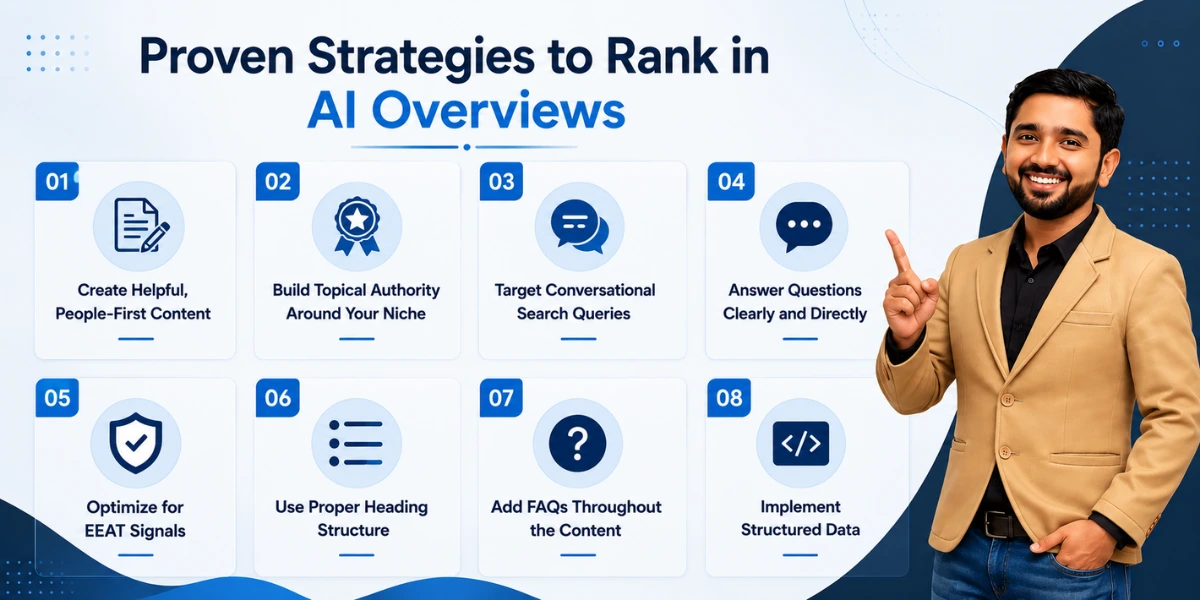
The first rule is simple: write for people before search engines. Google’s own guidance says that unique, valuable, people-first content remains important for visibility in generative AI search experiences.
Your content should solve real problems, answer real questions, and help readers make better decisions.
Avoid writing generic content that only repeats what other websites already say. Add examples, expert opinions, original frameworks, checklists, and practical steps.
To rank in AI Overviews, your website should become a trusted resource in your niche. This means publishing multiple connected pages around one topic.
For example, if your business offers AIO SEO services, create a complete content hub around artificial intelligence optimization, AI search, Google AI Overviews, AEO, GEO, content strategy, and technical SEO.
Internal linking is also important. Link related blogs together so users and search engines can easily understand the connection between your pages.
AI Overviews often appear for question-based and conversational queries. People search differently now. They ask full questions such as:
Use these questions as H2s, H3s, FAQs, and short answer sections inside your content.
AI systems prefer content that provides clear answers. Start important sections with a direct answer, then explain in detail.
For example:
“To rank in AI Overviews, businesses should create helpful content, build topical authority, improve EEAT, use structured headings, answer search intent clearly, and keep content updated.”
This type of direct answer is easy for users and AI systems to understand.
Add trust-building elements throughout your website. These may include:
If your website offers aio consulting, show why users should trust your advice. Explain your process, experience, and results.
Headings help users scan the page and help search engines understand the content. Use one H1, clear H2s, and supporting H3s.
Do not create headings only for keywords. Each heading should introduce a useful section. A strong structure improves readability and increases the chances that AI systems can identify important answers.
FAQs are powerful for AI search because they answer specific user questions. Add FAQ sections to blogs, service pages, and landing pages.
For example:
Can SEO help me rank in AI Overviews?
Yes. SEO helps because Google’s AI features still rely on core search systems, indexed content, technical accessibility, and helpful content quality.
Do I need schema to appear in AI Overviews?
Schema is not a guaranteed ranking factor for AI Overviews, but it helps search engines understand your content and can support rich result eligibility.
Structured data helps Google understand your page context. Use relevant schema such as Article, FAQ, Organization, LocalBusiness, Product, Service, and Breadcrumb schema.
Google says there is no special schema required for AI Overviews, but structured data remains useful as part of an overall SEO strategy.
Schema should match the visible content on your page. Do not add fake reviews, hidden FAQs, or misleading markup.
Ultimate guides perform well because they cover a topic deeply. A detailed guide on artificial intelligence optimization seo can explain definitions, strategies, examples, tools, FAQs, and future trends in one place.
These guides help AI systems understand that your page is comprehensive and useful.
Step-by-step tutorials are ideal for process-based searches. For example, a blog on “how to rank in AI Overviews SEO tips” can include a clear process:
This format is easy for users to follow and easy for AI systems to summarize.
Comparison content works well when users are evaluating options. Examples include:
Comparison pages help users make decisions and can attract commercial-intent traffic.
Lists and checklists are useful because they organize information clearly. A checklist for AI Overview optimization can include content quality, technical SEO, schema, internal links, author credibility, and content freshness.
These formats are practical and easy to scan.
FAQ content directly matches question-based search behavior. Since AI Overviews often respond to questions, FAQ sections can improve your chances of being understood as a helpful source.
Industry Research
Original research is highly valuable. If your business can publish survey data, case studies, traffic analysis, or expert insights, it can stand out from generic content.
AI systems may prefer unique information because it adds value beyond common knowledge.
Case Studies
Case studies show real experience. They prove that your strategies work in practical situations.
For example, a case study can explain how a business improved AI search visibility by updating content, adding FAQs, improving EEAT, and building topical clusters.
Start by tracking your target keywords. Monitor whether your website appears in traditional organic results, featured snippets, People Also Ask, and AI Overviews.
Use manual checks for important queries such as “how to rank in ai overviews,” “aio seo service,” and “aio consultant.”
Google Search Console is still important because AI feature traffic is included in Search Console’s web search performance reporting. Google states that sites appearing in AI features are included in overall search traffic data in the Performance report.
Review impressions, clicks, CTR, average position, and query trends. If impressions increase but clicks decrease, AI Overviews may be influencing user behavior.
Traffic alone is not enough. Check how users behave after landing on your site. Review engagement rate, time on page, scroll depth, conversions, form submissions, and call clicks.
AI Overview visitors may be more informed before they click, so they may convert better if your page answers their next question clearly.
AI search visibility is not limited to clicks. Track whether your brand is mentioned in AI responses, comparison queries, list articles, review platforms, and third-party websites.
Strong brand mentions can support trust and authority.
AI search is still evolving. Track referral traffic from AI platforms where possible, monitor branded search growth, and review changes in organic search behavior.
Businesses should combine SEO reporting with AI visibility tracking to understand the full impact.
Also Read: Google Ads for Local Businesses: Key Metrics That Drive Better Results
Search is becoming more visual and interactive. Users may search with text, images, video, and voice. Businesses should optimize not only written content but also images, videos, infographics, and product visuals.
AI search may become more personalized based on user behavior, location, preferences, and search history. This means businesses need strong brand signals and helpful content for different audience segments.
Users are asking longer, more natural questions. Content should sound human, answer questions clearly, and include conversational phrases.
Instead of only targeting short keywords, businesses should target complete questions and decision-based queries.
Agentic AI search is one of the biggest future trends. Google has already discussed agentic experiences where AI agents may interact with websites to complete tasks, compare information, or help users take action.
This means websites must be technically clean, accessible, fast, and easy for both users and AI systems to navigate.
As AI search grows, brand authority will become even more important. AI systems may rely on trusted sources, strong reputation signals, expert content, and consistent information across the web.
Businesses that invest in authority now will be better prepared for future search changes.
AI Overviews are changing how users discover information, compare businesses, and make decisions. Traditional SEO is still important, but it is no longer enough to focus only on keywords and rankings.
To improve AI Overview visibility, businesses need helpful content, technical SEO, EEAT signals, structured data, topical authority, and a clear content strategy.
AI Overviews favor helpful, authoritative content over keyword stuffing. That means your business should focus on answering real questions, building trust, and creating content that users genuinely find valuable.
If you are looking for the best aio consultants in india, choose someone who understands both traditional SEO and AI-powered search behavior. A strong consultant will not only optimize your website for rankings but also help your brand appear in the AI-driven search experiences where your customers are already looking.
By combining EEAT, technical SEO, schema, and high-quality content, your business can improve its chances of ranking in Google AI Overview results.
The future of SEO belongs to brands that are helpful, credible, and easy to understand. Start building trust and topical authority today to stay competitive in AI search beyond 2026.
AI Overviews are changing SEO: Businesses now need visibility in AI-generated answers, not just traditional Google rankings.
Helpful content improves AI visibility: Clear, useful, and answer-focused content has a better chance of appearing in AI Overviews.
Topical authority matters: Creating connected content around AIO, GEO, AEO, SEO, schema, and AI search helps build trust.
EEAT builds credibility: Expert authors, case studies, updated content, testimonials, and transparent business details support trust.
AI SEO needs ongoing tracking: Businesses should monitor rankings, Search Console data, brand mentions, engagement, and AI search visibility.

Mit Thakkar is a digital marketing consultant helping businesses improve SEO, AI Overview visibility, and AI search performance. He focuses on AIO, GEO, content strategy, EEAT, schema, and topical authority to help brands create helpful content that can rank better in Google Search and appear across AI-driven search experiences.