
Generative Engine Optimisation (GEO) helps businesses improve their visibility across AI-powered search platforms such as Google AI Overviews, ChatGPT Search, Perplexity, Microsoft Copilot and Gemini. It builds on traditional SEO by making content easier for AI systems to understand, retrieve, summarise and cite through clear answers, strong topical authority, structured information and credible evidence.
An effective GEO strategy combines human-first content, search-intent optimisation, entity clarity, E-E-A-T, structured data, technical SEO and high-quality external mentions. Businesses should measure success through AI citations, brand mentions, organic engagement, qualified leads and topic-cluster performance rather than relying only on conventional rankings and clicks.
Search is no longer limited to a page of blue links. AI-powered platforms now interpret complex questions, compare information from multiple sources and present direct, conversational responses. This change is reshaping how customers discover businesses, evaluate services and make purchasing decisions. Companies now need more than traditional rankings; they need content that AI systems can understand, trust and confidently reference.
The scale of this change is significant. Google reported in July 2025 that AI Overviews had more than 2 billion monthly users across over 200 countries and territories and 40 languages. A Pew Research Center analysis also found that users clicked a traditional result in only 8% of visits when an AI summary appeared, compared with 15% when no summary was shown. These figures show why visibility inside AI-generated answers matters, even when a website already performs well organically.
This is where GEO consultancy services become valuable. Generative Engine Optimisation, or GEO, improves the likelihood that a brand, website or expert is discovered, understood and cited by AI-powered search experiences. Traditional SEO remains essential, but it must now be supported by stronger topical authority, clearer entities, credible evidence and content built around complete user questions.
This guide explains the most effective GEO best practices, how AI-powered search engines select information, which content formats perform well and how businesses can measure progress.
Generative Engine Optimisation is the process of improving digital content so that generative AI systems can interpret, retrieve and use it when answering a user’s question. The goal is not simply to rank a webpage for a keyword. It is to make the business a reliable source that AI platforms may mention, summarise or cite.
Traditional SEO mainly focuses on rankings, organic clicks and visibility in standard results. GEO builds on those foundations but gives additional attention to clear answers, entity relationships, expert insights, original evidence, structured information and consistent brand mentions.
Google’s current guidance states that established SEO practices remain relevant because its generative search features are connected to core Search ranking and quality systems. Businesses should therefore treat GEO as an extension of good SEO rather than a replacement for it.
AI-generated answers are becoming part of the normal search experience because they help users understand complicated topics, compare options and explore detailed questions without opening many pages.
GEO can increase visibility beyond standard search listings. A brand referenced in an AI answer may reach users who might never scroll through organic results.
Consistent inclusion in useful answers can also build brand authority. When AI platforms repeatedly associate a company with a service, industry or topic, the business becomes easier to recognise and trust.
GEO may also attract better-qualified traffic. People who visit a cited source after reading an AI summary often want deeper information, proof, pricing, examples or professional support. Businesses that start early can build authority before competitors invest in the same area.
AI-powered search engines combine information retrieval, language understanding and content synthesis. Although platforms use different systems, the process usually includes four stages.
Understand intent: The system identifies what the person wants to achieve, including topic, context and likely next action.
Retrieve info: It searches its index, connected sources or live web results for relevant material.
Select source: It compares relevance, clarity, credibility, freshness and consistency.
Create response: It combines selected information into a direct answer, often with links or citations.
This is why isolated keyword targeting is becoming less effective. AI systems need context to understand what a business does, who it serves, where it operates and why its information deserves attention.
Businesses should consider visibility across several search experiences:
Google AI Overviews: Summarises information within Google Search and links to supporting sources.
ChatGPT Search: Provides conversational answers supported by web sources.
Perplexity AI: Focuses on answer-based research with visible citations.
Microsoft Copilot: Combines AI assistance with Microsoft’s search ecosystem.
Gemini: Helps users research, compare and explore topics within Google’s AI ecosystem.
These platforms differ in interface and source selection, but they all benefit from content that is clear, specific, useful and trustworthy.
Ranking on page one does not automatically guarantee inclusion in an AI-generated answer. An AI system may select a lower-ranking source if it provides a clearer explanation, stronger evidence or a more direct answer.
This is one reason businesses increasingly work with a GEO expert in India or another experienced market. The work involves more than placing keywords into existing pages. It requires reviewing content depth, entity clarity, authority, citations, technical accessibility and the questions customers ask during their buying journey.
Keyword stuffing is also less effective because generative systems evaluate meaning and relationships rather than keyword density alone. A page that repeats a phrase but fails to explain the topic fully is unlikely to become a dependable source.
An entity is a clearly identifiable person, company, product, place, service or concept. Search engines connect entities to understand relationships.
For example, a software company may be associated with particular services, industries, technologies, locations, leaders and customer results. When these relationships appear consistently across the website and reliable external sources, AI systems can understand the business more accurately.
A successful GEO strategy therefore focuses on defining important entities, building semantic relevance, developing topical authority, matching user intent and maintaining consistent business information across the web.
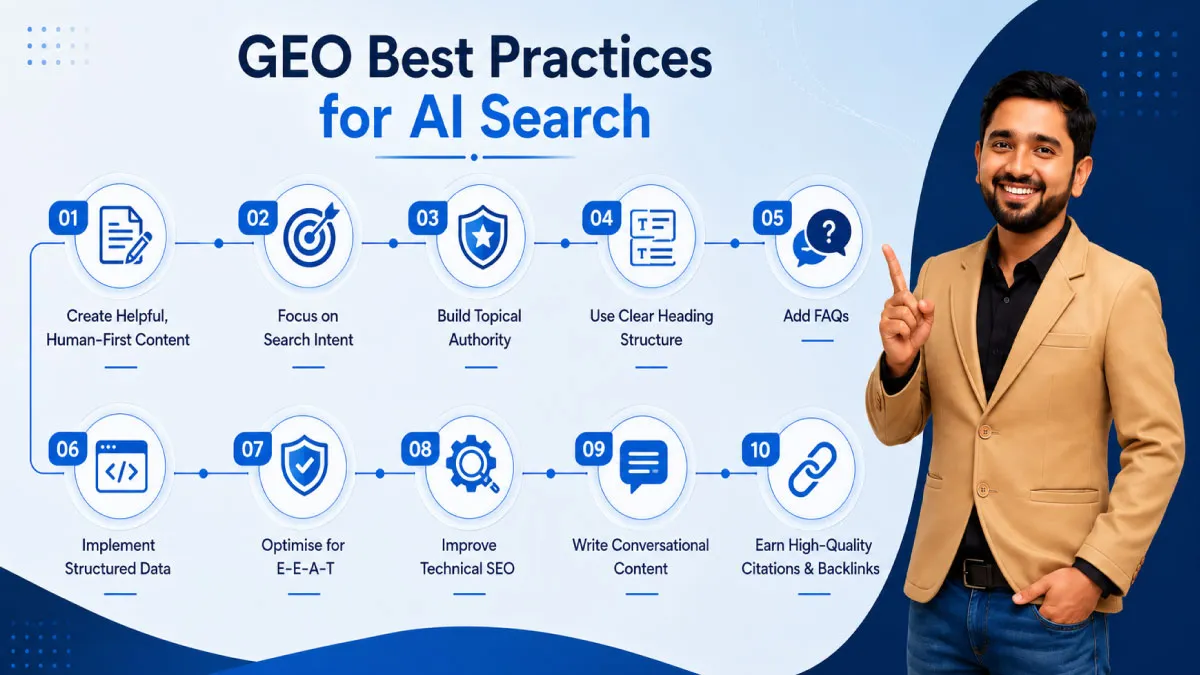
Strong content solves a genuine problem. Identify what customers want to know before contacting the business, then provide a complete answer with practical explanations, examples, limitations and next steps.
Avoid writing only for algorithms. Natural content is easier for readers to understand and easier for AI systems to summarise. Google also recommends unique, reliable and people-first content that offers value beyond common information already available online.
Every page should have a clear purpose:
Content that satisfies the wrong intent may attract impressions but is unlikely to deliver strong engagement or conversions.
Do not publish disconnected articles. Create organised clusters around your core services.
A pillar page can explain a broad topic, while supporting pages answer questions about cost, process, benefits, comparisons, industries and implementation. Connect them with purposeful internal links.
This structure helps readers explore a subject and signals that the website offers comprehensive coverage.
Use one descriptive H1 followed by logically organised H2 and H3 headings. Keep sections focused and avoid large walls of text.
Descriptive headings help readers scan the page and help AI systems understand what each section covers. “How to Measure GEO Success” is clearer than a vague heading such as “Results”.
FAQs can answer conversational searches that may not fit naturally into the main article. Use real sales questions, support queries and consultation conversations to find useful topics.
Keep each response direct and complete. Do not repeat existing content simply to increase page length.
Structured data helps search engines understand the meaning and purpose of a page. Useful types may include:
Google explains that structured data can make pages eligible for richer search appearances, but it does not guarantee a particular result or AI citation.
E-E-A-T refers to experience, expertise, authoritativeness and trustworthiness.
Show experience through case studies, examples, tested processes and lessons learned. Demonstrate expertise with accurate explanations and qualified authors. Build authority through research and reputable mentions. Strengthen trust with clear contact details, transparent policies, secure browsing and honest claims.
For finance, health, legal or safety topics, strong evidence and professional review are especially important.
AI visibility still depends on content being accessible. Prioritise fast loading, mobile responsiveness, HTTPS, healthy Core Web Vitals, logical site architecture, crawlable pages, accurate canonical tags, updated XML sitemaps and correct robots directives.
Technical issues can prevent useful content from being discovered, indexed or interpreted properly.
People increasingly search using complete questions. Reflect this behaviour in your writing.
Use natural language, short explanations, real examples, numbered steps, bullet lists and comparison tables where they improve understanding. Define technical terms before using them repeatedly.
The best GEO techniques make complex subjects easier to understand rather than making the content sound unnecessarily technical.
Trusted external mentions can strengthen brand authority. Focus on industry publications, expert interviews, digital PR, relevant guest contributions, original research and useful resources that other websites naturally reference.
Avoid low-quality links or artificial mentions. Google’s guidance warns that inauthentic mentions and unsupported GEO “hacks” are not substitutes for quality content and legitimate authority.
A skilled GEO specialist will usually recommend a mix of formats:
Choose the format according to the query. A comparison search requires balanced criteria, while an implementation question benefits from ordered steps, timelines and common mistakes.
GEO measurement is still developing, so businesses should track visibility, engagement and commercial outcomes together.
Monitor whether the brand appears in AI answers for important non-branded questions. Record the query, platform, cited page and response context.
Track branded search growth, external mentions, organic traffic, landing-page engagement, assisted conversions and enquiry quality. Lower click volume does not always mean lower value when visitors arrive with stronger intent.
Useful indicators include:
Google Search Console remains important for measuring search performance, although AI visibility reporting and platform-level data can vary.
Create a baseline before major changes and review progress monthly or quarterly.
AI-powered search is already influencing how customers discover information and compare companies. Waiting for every platform and measurement method to mature may allow competitors to establish stronger authority first.
Starting now can help a business improve AI visibility, build expertise around valuable topics, support buyers at every stage, increase trust and reduce dependence on a small group of high-volume keywords.
The right approach is not to chase every new tactic. Follow sustainable GEO guidelines: publish genuinely useful information, organise it clearly, prove expertise, maintain technical accessibility and earn trustworthy recognition.
Businesses evaluating GEO consulting services should check whether the provider understands traditional SEO, content strategy, schema, analytics, digital PR and conversion optimisation. GEO performs best when these areas work together.
Ranking in AI-powered search results requires more than repeating keywords or publishing large volumes of generic content. Businesses need helpful answers, strong topical authority, clear entities, structured information, credible evidence and technically sound websites.
The core SEO GEO best practices are straightforward: understand intent, create human-first content, organise topics into connected clusters, use descriptive headings, add suitable structured data, demonstrate E-E-A-T and earn credible mentions. These actions improve the reader experience while strengthening the signals search and generative systems use to understand content.
The right best GEO consultant will not promise guaranteed AI citations or depend on short-term tricks. A reliable consultant will study customer questions, identify content gaps, improve authority and create a measurable plan around business outcomes.
For companies comparing a GEO consultant India option or looking for a GEO specialist, strategic understanding matters more than keyword placement alone. Select a partner who can combine research, content quality, technical SEO, structured data and reporting into one practical roadmap.
AI search will continue to evolve, but one principle is likely to remain stable: businesses that provide clear, useful and trustworthy information will have the strongest opportunity to be discovered.
GEO strengthens traditional SEO: Generative Engine Optimisation does not replace SEO. It adds clearer answers, stronger entity relationships, expert insights and structured content to improve AI search visibility.
Helpful, intent-focused content performs better: Businesses should answer complete customer questions with practical explanations, relevant examples and content aligned with informational, commercial, transactional or navigational intent.
Topical authority improves AI understanding: Connected pillar pages, supporting articles and purposeful internal links help search engines and AI platforms understand a business’s expertise across a subject.
E-E-A-T and technical SEO build trust: Case studies, qualified authors, credible evidence, secure websites, fast loading and crawlable pages support stronger search and AI visibility.
GEO success requires ongoing measurement: Track AI answer citations, priority prompt visibility, branded searches, engagement, referring domains, qualified leads and conversion performance.


Mit Thakkar is a digital marketing consultant helping businesses improve SEO, AI Overview visibility, and AI search performance. He focuses on AIO, GEO, content strategy, EEAT, schema, and topical authority to help brands create helpful content that can rank better in Google Search and appear across AI-driven search experiences.